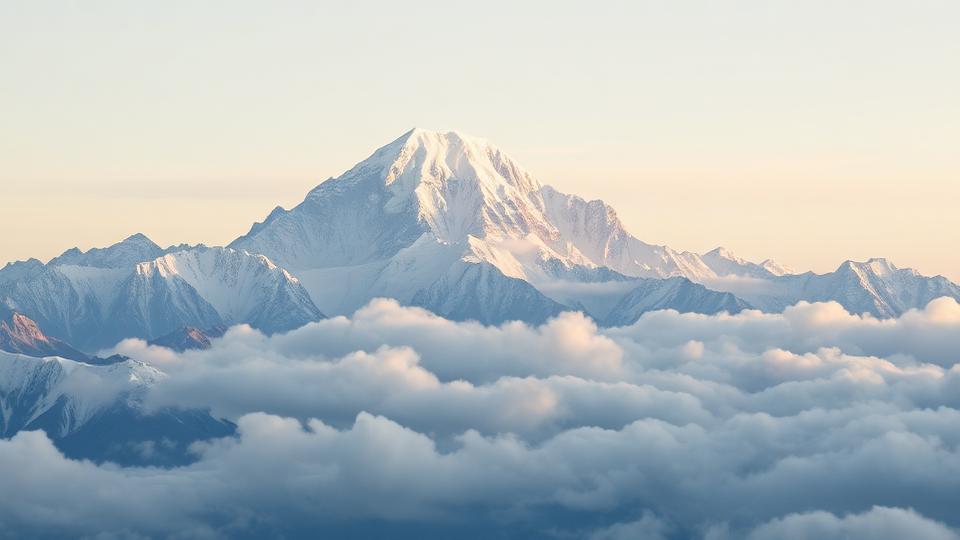
What Is the Tallest Mountain in the World?
The answer seems obvious — but it actually depends on how you measure. The tallest mountain above sea level, from base to summit, and farthest from Earth's center are three different peaks.
Quick Answer
Mount Everest is the tallest mountain above sea level, standing at 8,849 meters (29,032 feet). However, Mauna Kea in Hawaii is the tallest from base to summit (10,210 m), and Chimborazo in Ecuador is the farthest point from Earth's center.
Mount Everest, located on the border between Nepal and Tibet (China) in the Himalayan mountain range, has been recognized as Earth's highest point above sea level since 1856. Its summit reaches 8,849 meters (29,032 feet), a measurement confirmed by a joint Nepalese-Chinese survey in 2020.
But the question 'tallest mountain' has multiple valid answers. If you measure from base to summit, Hawaii's Mauna Kea wins at approximately 10,210 meters — but most of it is underwater. Only about 4,207 meters rise above sea level.
There's yet another contender: Ecuador's Chimborazo volcano. Because Earth is not a perfect sphere but bulges at the equator, Chimborazo's summit is actually the farthest point from Earth's center — about 6,384.4 km from the core, compared to Everest's 6,382.3 km.
Mount Everest continues to grow by approximately 4 millimeters per year due to tectonic forces pushing the Indian plate under the Eurasian plate. However, the devastating 2015 Nepal earthquake may have slightly reduced its height, though subsequent surveys confirmed it at 8,849 meters.
Key Fact
Mount Everest stands at 8,849 meters (29,032 feet) above sea level, making it the highest point on Earth. It grows about 4 mm taller each year due to ongoing tectonic activity.
Why It Matters
Mount Everest and the broader study of extreme elevation have taught us enormous amounts about geology, human physiology, and climate science. Research at high altitudes has led to medical advances in understanding oxygen deprivation, which applies to aviation medicine and intensive care. The Himalayas also serve as a critical water source — glacial melt from these mountains provides freshwater to over 1.5 billion people across Asia. Climate change is causing Himalayan glaciers to retreat at an accelerating rate, threatening water security for a significant portion of the world's population.
Did You Know?
- •Over 6,000 people have successfully summited Everest, but more than 300 climbers have died attempting it.
- •The summit of Everest is made of marine limestone — rock that formed at the bottom of an ancient sea about 450 million years ago.
- •There are an estimated 200 bodies still on Mount Everest, some of which serve as waypoints for climbers.
- •The jet stream can push wind speeds at the summit to over 280 km/h (175 mph).
- •Everest has multiple names: Sagarmatha (Nepal), Chomolungma (Tibet), and Everest (named after British surveyor Sir George Everest).
How Mount Everest's Height Is Measured
The modern techniques used to determine the world's tallest peak.
- 1
Use GPS satellites
Modern measurements use GPS receivers placed at the summit to triangulate the precise elevation using satellite signals.
- 2
Account for sea level
Height is measured from mean sea level (the geoid). Everest's official height is 8,848.86 meters (29,031.7 feet) as confirmed in 2020.
- 3
Consider the alternative
Measured from base to peak, Mauna Kea in Hawaii is actually taller at 10,210 meters — but most of it is underwater.
Key Dates
1856
The Great Trigonometric Survey identified Everest as the world's highest peak
1924
George Mallory and Andrew Irvine disappeared near the summit — whether they reached it remains a mystery
1953
Edmund Hillary and Tenzing Norgay became the first confirmed climbers to reach the summit
1975
Junko Tabei became the first woman to summit Everest
2020
China and Nepal jointly confirmed the official height at 8,849 meters
Related Facts
- •The deepest point in the ocean reaches nearly 11,000 meters below sea level
- •Earth is approximately 4.54 billion years old
- •The highest mountain in the solar system is Olympus Mons on Mars at 21,900 meters
- •K2, the second-tallest mountain, is considered far more dangerous to climb than Everest
Frequently Asked Questions
Explore More
Want to explore more about our planet's incredible extremes? Discover more facts.
Explore SnapFacts