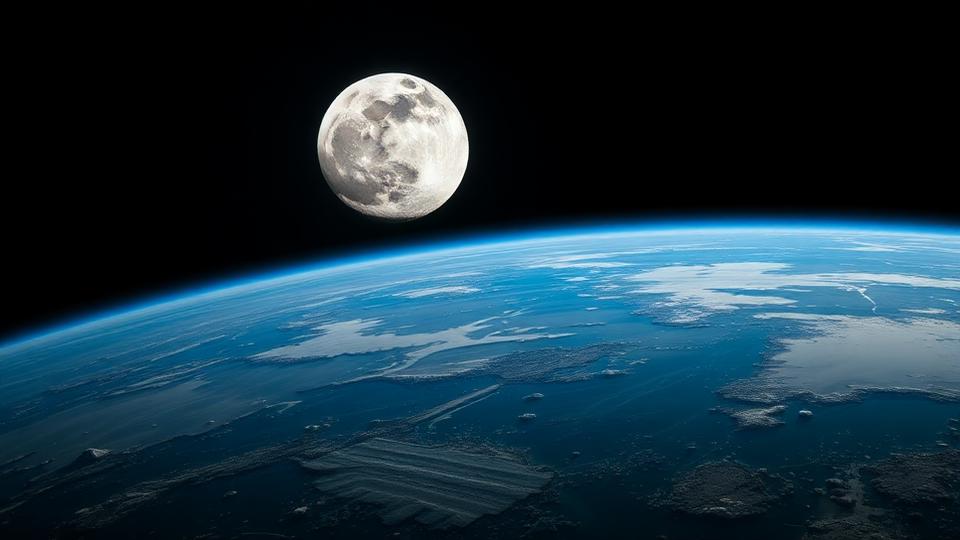
How Far Is the Moon from Earth?
The Moon is our closest celestial neighbor, but it's still far enough away that you could fit every planet in the solar system between Earth and the Moon — with room to spare.
Quick Answer
The Moon orbits Earth at an average distance of about 384,400 kilometers (238,855 miles). This distance varies between 356,500 km at its closest (perigee) and 406,700 km at its farthest (apogee).
The Moon doesn't orbit Earth in a perfect circle — its orbit is slightly elliptical, which means the distance changes constantly. At its closest (perigee), the Moon is about 356,500 km away; at its farthest (apogee), it's about 406,700 km away. The average distance of 384,400 km is what most references cite.
To put this distance in perspective: light takes about 1.28 seconds to travel from the Moon to Earth. If you could drive a car at highway speed (100 km/h) non-stop, it would take about 160 days to reach the Moon. The Apollo missions took about 3 days to make the journey.
Here's an astounding fact: all seven of the other planets in our solar system — Mercury, Venus, Mars, Jupiter, Saturn, Uranus, and Neptune — could fit side by side in the gap between Earth and the Moon. Their combined diameters total about 380,016 km, just fitting within the average Earth-Moon distance.
The Moon is slowly moving away from Earth at a rate of about 3.8 centimeters (1.5 inches) per year. Scientists know this precisely because Apollo astronauts left retroreflectors on the lunar surface, and researchers on Earth bounce laser beams off them to measure the exact distance to within millimeter accuracy.
Key Fact
The Moon orbits Earth at an average distance of 384,400 km (238,855 miles) — far enough that all the other planets in our solar system could fit in the space between.
Why It Matters
The Earth-Moon distance has profound effects on our planet. The Moon's gravitational pull creates ocean tides, stabilizes Earth's axial tilt (which gives us stable seasons), and slows Earth's rotation. Without the Moon at its current distance, Earth's days would be only about 6–8 hours long, winds would be much stronger, and our climate would be far less stable. Understanding the lunar distance is also critical for planning future Moon missions, including NASA's Artemis program, which aims to establish a permanent human presence on the Moon.
Did You Know?
- •All seven other planets in our solar system can fit between Earth and the Moon with room to spare.
- •The Moon is moving away from Earth at 3.8 cm per year. In about 600 million years, total solar eclipses will no longer be possible.
- •Light takes about 1.28 seconds to travel from the Moon to Earth.
- •The Apollo 11 mission took 3 days, 3 hours, and 49 minutes to travel from Earth to lunar orbit.
- •Scientists can measure the Earth-Moon distance to within a few millimeters using laser reflectors left by Apollo astronauts.
How Scientists Measure the Distance to the Moon
The precise method used to calculate Earth-Moon distance.
- 1
Use laser ranging
Scientists fire lasers at retroreflectors left on the Moon by Apollo astronauts and measure the time for light to bounce back.
- 2
Calculate with speed of light
Light travels at 299,792 km/s. The round trip takes about 2.5 seconds, giving a distance of approximately 384,400 km.
- 3
Account for orbital variation
The Moon's orbit is elliptical, so the distance varies from 356,500 km (perigee) to 406,700 km (apogee).
Key Dates
150 BC
Greek astronomer Hipparchus calculated the Moon's distance with remarkable accuracy
1946
First radar signals bounced off the Moon confirmed the distance measurement
1969
Apollo 11 astronauts placed retroreflectors on the Moon for precise laser ranging
2024
NASA's Artemis program continues preparations for crewed lunar missions
Related Facts
Frequently Asked Questions
Explore More
Curious about the cosmos? Explore more space and astronomy facts.
Explore SnapFacts