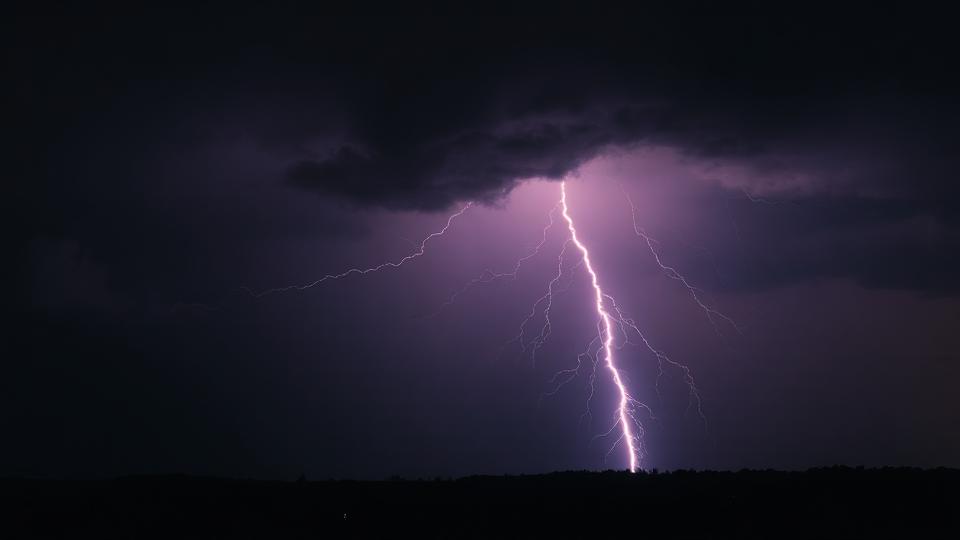
What Causes Lightning?
Lightning is one of nature's most spectacular and terrifying displays — a bolt hotter than the surface of the sun, created by invisible forces inside ordinary clouds.
Quick Answer
Lightning is caused by the buildup and discharge of electrical energy between regions of opposite charge within a thundercloud, or between a cloud and the ground. Ice particles colliding inside the cloud create this charge separation.
Inside a thundercloud (cumulonimbus), strong updrafts carry water droplets high into the atmosphere where they freeze into ice crystals. As these ice particles collide with each other and with heavier graupel (soft hail), electrons are knocked off — creating a separation of electrical charge.
Lighter, positively charged ice crystals rise to the top of the cloud, while heavier, negatively charged particles sink to the bottom. This creates an enormous electrical potential difference — sometimes hundreds of millions of volts — between the top and bottom of the cloud.
When the electrical potential becomes strong enough to overcome the insulating properties of air, a massive electrical discharge occurs — that's lightning. A typical bolt carries about 300 million volts and 30,000 amps of current, heating the surrounding air to about 30,000°C (54,000°F) — roughly five times hotter than the surface of the sun.
The intense heat causes the air to expand explosively, creating a shockwave we hear as thunder. Since light travels much faster than sound, we see the lightning before we hear the thunder. You can estimate a lightning bolt's distance by counting the seconds between the flash and the thunder and dividing by 5 (for miles) or 3 (for kilometers).
Key Fact
A single lightning bolt can reach temperatures of 30,000°C (54,000°F) — about five times hotter than the surface of the sun — and carries enough energy to toast 100,000 slices of bread.
Why It Matters
Lightning research has practical implications far beyond weather forecasting. Understanding lightning helps protect power grids, aircraft, and telecommunications infrastructure. Lightning is also a significant cause of wildfires worldwide and plays a role in atmospheric chemistry by producing nitrogen oxides that affect ozone levels. Scientists believe lightning may have been essential for the origin of life on Earth, as it could have helped create the complex organic molecules needed for the first living organisms.
Did You Know?
- •Earth is struck by lightning about 100 times every second — that's roughly 8.6 million strikes per day.
- •Lightning can and does strike the same place twice. The Empire State Building is struck about 20–25 times per year.
- •The longest recorded lightning bolt stretched 768 km (477 miles) across the southern United States in 2020.
- •Ball lightning — a mysterious glowing sphere that appears during thunderstorms — has been observed for centuries but is still not fully understood by science.
- •Venezuela's Lake Maracaibo has the most lightning strikes of any place on Earth, with storms occurring up to 300 nights per year.
How Lightning Forms in a Thunderstorm
The physics behind electrical discharge in storm clouds.
- 1
Charge separation occurs
Inside a cumulonimbus cloud, collisions between ice crystals and water droplets create positive charges at the top and negative charges at the bottom.
- 2
Electric field builds
As the charge difference grows, it creates an enormous electric field between the cloud base and the ground (or between clouds).
- 3
A stepped leader descends
When the field is strong enough, a channel of ionized air (stepped leader) zigzags downward from the cloud toward the ground.
- 4
The return stroke flashes
When the leader connects with a positive streamer rising from the ground, a massive electrical current flows — creating the visible lightning bolt at up to 30,000°C.
Key Dates
1752
Benjamin Franklin's kite experiment proved that lightning is electrical in nature
1882
The first lightning rods, based on Franklin's design, became widely used to protect buildings
1969
Apollo 12 was struck by lightning during launch but continued safely to the Moon
2020
The longest single lightning bolt ever recorded stretched 768 km across three US states
Related Facts
Frequently Asked Questions
Explore More
Want to learn more about Earth's powerful natural forces? Explore more science facts.
Explore SnapFacts