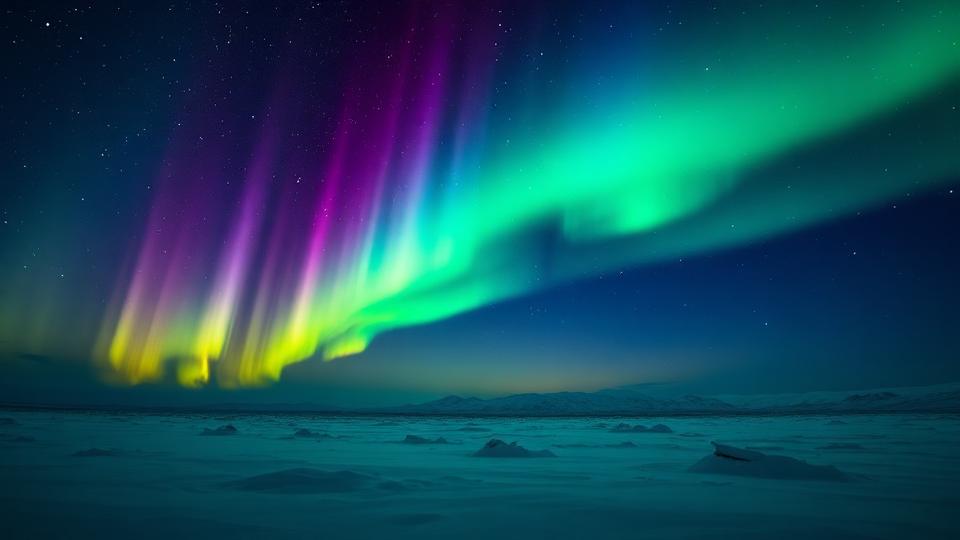
What Causes the Northern Lights?
The aurora borealis is one of nature's most breathtaking spectacles — curtains of light dancing across the sky, powered by explosions on the sun 150 million kilometers away.
Quick Answer
The Northern Lights (aurora borealis) are caused by charged particles from the sun (solar wind) colliding with gases in Earth's atmosphere. These collisions excite atmospheric molecules, which then release energy as colorful light — green from oxygen, purple and blue from nitrogen.
The process begins on the sun, which constantly emits a stream of charged particles called the solar wind. During solar flares and coronal mass ejections, the sun releases especially large bursts of these particles into space at speeds of up to 1,000 km per second.
When these charged particles reach Earth (typically after 2–3 days of travel), most are deflected by Earth's magnetic field. However, some particles are funneled along magnetic field lines toward the poles, where they enter the upper atmosphere at altitudes of 100–300 km.
As these energetic particles collide with oxygen and nitrogen molecules in the atmosphere, they transfer energy to those molecules. The excited molecules then release this energy as photons (light). Oxygen produces green and red light, while nitrogen produces blue and purple hues. The specific colors depend on the altitude and type of gas involved.
The aurora occurs in an oval-shaped ring around the magnetic poles, which is why they're most commonly seen at high latitudes (60–75° north or south). During strong solar storms, however, the auroral oval expands, and the Northern Lights can be visible much farther south — even as far as the Mediterranean in rare cases.
Key Fact
The Northern Lights are essentially Earth's atmosphere fluorescing — charged solar particles excite oxygen and nitrogen molecules 100–300 km above the surface, producing curtains of green, red, blue, and purple light.
Why It Matters
Understanding the aurora is crucial for space weather forecasting. Severe geomagnetic storms can damage satellites, disrupt GPS systems, affect airline communications on polar routes, and even cause widespread power grid failures. As our civilization becomes increasingly dependent on technology, monitoring solar activity and predicting its effects on Earth becomes ever more important. Aurora research also helps scientists understand magnetic fields on other planets and the behavior of plasma — the most common state of matter in the universe.
Did You Know?
- •The Southern Hemisphere has its own version called the aurora australis (Southern Lights), which mirrors the Northern Lights.
- •Auroras also occur on other planets — Jupiter, Saturn, Uranus, and Neptune all have spectacular auroral displays.
- •The Northern Lights can generate electrical currents strong enough to disrupt power grids. In 1989, a geomagnetic storm caused a 12-hour blackout across Quebec, Canada.
- •The aurora can extend hundreds of kilometers into space, but the most visible activity occurs at 100–300 km altitude.
- •Norwegian scientist Kristian Birkeland correctly theorized the cause of the aurora in 1908, but his theory wasn't fully confirmed until the space age.
How to See the Northern Lights
A practical guide to maximizing your chances of witnessing the aurora borealis.
- 1
Choose the right location
Travel to high-latitude areas (60-75° N) like northern Norway, Iceland, Finland, or Alaska for the best viewing.
- 2
Pick the right time
September to March offers the darkest skies. The hours around midnight typically provide peak activity.
- 3
Check solar activity
Monitor aurora forecasts and the Kp index — values of 3+ indicate good chances. Higher solar activity means brighter displays.
- 4
Find dark skies
Get away from city light pollution, find a clear horizon facing north, and allow your eyes 20+ minutes to adjust to darkness.
Key Dates
1621
Pierre Gassendi coined the term 'aurora borealis' after the Roman goddess of dawn
1908
Kristian Birkeland proposed that solar particles cause the aurora
1958
Explorer 1 satellite confirmed the existence of Earth's radiation belts, validating aurora theory
1989
A massive geomagnetic storm caused a 12-hour blackout across Quebec, demonstrating aurora's power
2025
Solar Cycle 25 peak brought unusually vivid auroral displays visible at lower latitudes worldwide
Related Facts
Frequently Asked Questions
Explore More
Want to explore more about the wonders of our planet and sky? Discover more facts.
Explore SnapFacts