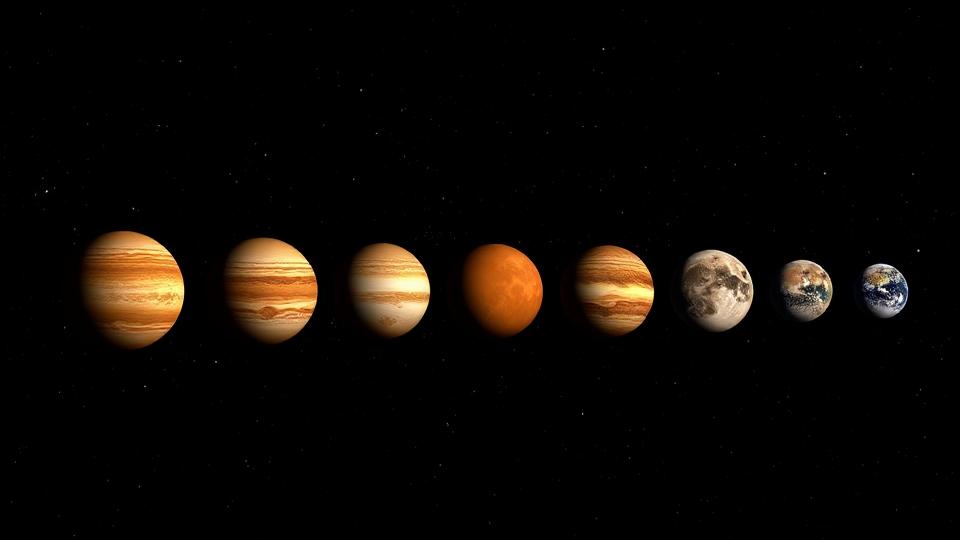
How Many Planets Are in the Solar System?
The answer was 9 for decades — until 2006, when astronomers made a controversial decision that changed textbooks around the world.
Quick Answer
There are 8 officially recognized planets in our solar system: Mercury, Venus, Earth, Mars, Jupiter, Saturn, Uranus, and Neptune. Pluto was reclassified as a 'dwarf planet' in 2006 by the International Astronomical Union (IAU).
For 76 years after its discovery in 1930, Pluto was considered the ninth planet. That changed in 2006 when the International Astronomical Union (IAU) established the first formal definition of a planet. To qualify, a celestial body must: (1) orbit the sun, (2) have sufficient mass for gravity to make it roughly spherical, and (3) have 'cleared the neighborhood' around its orbit of other debris.
Pluto meets the first two criteria but fails the third — its orbit overlaps with other objects in the Kuiper Belt. This led to its reclassification as a 'dwarf planet,' a decision that remains controversial among some astronomers and the public. The debate was so heated that the state of New Mexico passed a resolution declaring that Pluto would always be considered a planet within its borders.
The 8 planets divide into two groups: the 4 inner rocky (terrestrial) planets — Mercury, Venus, Earth, and Mars — and the 4 outer gas and ice giants — Jupiter, Saturn, Uranus, and Neptune. Jupiter, the largest, could fit over 1,300 Earths inside it, while Mercury, the smallest, is only slightly larger than our Moon.
Beyond the 8 planets, our solar system contains 5 officially recognized dwarf planets (Pluto, Eris, Ceres, Haumea, and Makemake), hundreds of moons, millions of asteroids, and trillions of comets. Some scientists believe a hypothetical 'Planet Nine' may exist in the outer solar system, but it has never been directly observed.
Key Fact
Our solar system has 8 official planets. Jupiter is the largest (11× Earth's diameter), Mercury is the smallest, and Earth is the only one known to support life.
Why It Matters
Understanding our solar system's planets provides crucial context for the search for life beyond Earth. NASA's missions to Mars, Jupiter's moon Europa, and Saturn's moon Enceladus are driven by the possibility of finding water and potentially microbial life. The study of our neighboring planets also helps us understand climate change on Earth — Venus is a cautionary example of runaway greenhouse effect, while Mars shows what happens when a planet loses its magnetic field and atmosphere. Exoplanet discoveries are now cataloging thousands of worlds around other stars, making planetary science more relevant than ever.
Did You Know?
- •Jupiter's Great Red Spot is a storm larger than Earth that has been raging for at least 350 years.
- •A day on Venus (243 Earth days) is longer than a year on Venus (225 Earth days) — it rotates extremely slowly and in the opposite direction.
- •Saturn's density is so low that it would float in water if you could find a bathtub large enough.
- •Uranus rotates on its side, with its axis tilted 98 degrees — possibly from a massive collision billions of years ago.
- •Neptune's moon Triton orbits in the opposite direction of the planet's rotation, suggesting it was captured from the Kuiper Belt.
How to Remember All 8 Planets in Order
A quick mnemonic trick to remember all planets from Mercury to Neptune.
- 1
Learn the mnemonic
Use 'My Very Educated Mother Just Served Us Nachos' — each first letter matches a planet in order from the sun.
- 2
Match the planets
Mercury, Venus, Earth, Mars, Jupiter, Saturn, Uranus, Neptune — four rocky inner planets, then four gas/ice giants.
- 3
Remember the divider
The asteroid belt between Mars and Jupiter separates the small rocky planets from the massive outer gas giants.
Key Dates
1781
William Herschel discovered Uranus — the first planet found using a telescope
1846
Neptune was discovered through mathematical prediction — a triumph of orbital mechanics
1930
Clyde Tombaugh discovered Pluto, which was classified as the ninth planet
2006
The IAU redefined 'planet' and reclassified Pluto as a dwarf planet
2015
NASA's New Horizons spacecraft flew by Pluto, revealing a complex and geologically active world
Related Facts
Frequently Asked Questions
Explore More
Explore the cosmos and discover more incredible space facts.
Explore SnapFacts