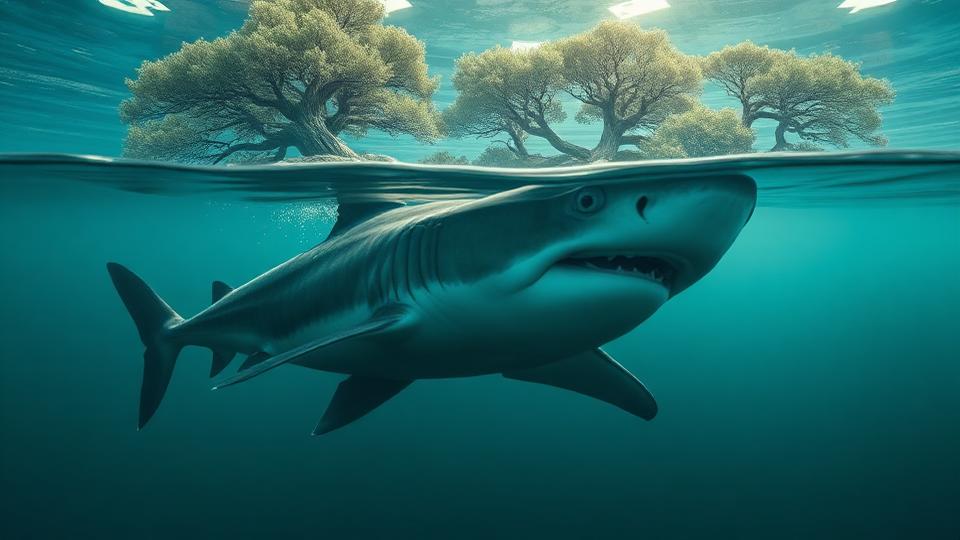
Are Sharks Older Than Trees?
Sharks have been swimming in Earth's oceans for over 450 million years — that's about 90 million years before the first trees appeared.
Quick Answer
Yes. Sharks first appeared approximately 450 million years ago, while the earliest trees evolved around 360 million years ago. This means sharks are roughly 90 million years older than trees.
The earliest shark-like creatures appeared during the Late Ordovician period, about 450 million years ago. These ancient sharks looked very different from modern species — they were small, with simple teeth and no bones (shark skeletons are made entirely of cartilage, which is why so few complete fossils exist). The oldest confirmed shark fossils are scales found in Siberia and Colorado, dating to roughly 450 million years ago.
Trees, on the other hand, didn't appear until the Late Devonian period, around 360 million years ago. The earliest known tree species, Archaeopteris, grew up to 30 meters tall and formed the first forests. Before trees existed, land plants were small and moss-like. The evolution of trees fundamentally changed Earth's atmosphere by absorbing CO₂ and producing oxygen on a massive scale.
To put this in perspective: sharks survived the five major mass extinction events in Earth's history, including the Permian-Triassic extinction (which wiped out 96% of marine species) and the asteroid impact that killed the dinosaurs 66 million years ago. Their cartilage-based skeleton, efficient hunting abilities, and adaptable biology have made them one of the most successful groups of animals in evolutionary history.
Modern sharks belong to a group called Selachimorpha and include over 500 species, ranging from the 17-centimeter dwarf lanternshark to the 12-meter whale shark. Despite their incredible evolutionary success, many shark species are now threatened by human activities including overfishing, habitat destruction, and the shark fin trade.
Key Fact
Sharks have existed for over 450 million years — about 90 million years longer than trees, 200 million years before dinosaurs, and 449.7 million years before humans.
Why It Matters
The fact that sharks predate trees reveals how ancient and resilient ocean ecosystems are. Sharks play a critical role as apex predators, maintaining the health of marine food chains. Their evolutionary persistence through five mass extinctions makes them invaluable for scientific research into survival, adaptation, and climate change. Despite surviving for nearly half a billion years, many shark species now face extinction due to human activity — a sobering reminder of our impact on Earth's oldest surviving predators.
Did You Know?
- •Sharks predate Saturn's rings — the rings are estimated to be only 100-400 million years old, while sharks have existed for 450 million years.
- •The Greenland shark can live for over 400 years, making it the longest-lived vertebrate on Earth. Scientists determined this using radiocarbon dating of eye lens proteins.
- •Sharks don't have a single bone in their body — their entire skeleton is made of cartilage, the same flexible tissue in your nose and ears.
- •Some shark species must swim constantly to breathe, as they need water flowing over their gills. If they stop, they suffocate.
- •The megalodon, the largest shark that ever lived, grew up to 18 meters long and went extinct about 3.6 million years ago.
How to Understand Shark Evolution Timeline
Placing sharks and trees on the geological timeline to grasp their relative ages.
- 1
Date the first sharks
Shark-like fish first appeared about 450 million years ago in the Ordovician period, based on fossil scales and teeth found in ancient rock layers.
- 2
Date the first trees
The earliest trees (Archaeopteris) appeared about 385 million years ago in the late Devonian period.
- 3
Calculate the difference
Sharks predate trees by approximately 65 million years — they survived all five major mass extinctions, including the one that killed the dinosaurs.
Key Dates
~450 MYA
First shark-like creatures appear in Earth's oceans (Late Ordovician).
~360 MYA
First trees (Archaeopteris) evolve, forming Earth's earliest forests.
~252 MYA
Sharks survive the Great Dying — the largest mass extinction in history.
~66 MYA
Sharks survive the asteroid impact that wipes out the dinosaurs.
~3.6 MYA
Megalodon, the largest shark ever, goes extinct.
Related Facts
Frequently Asked Questions
Explore More
Explore more fascinating facts about animals, evolution, and the natural world.
Explore SnapFacts