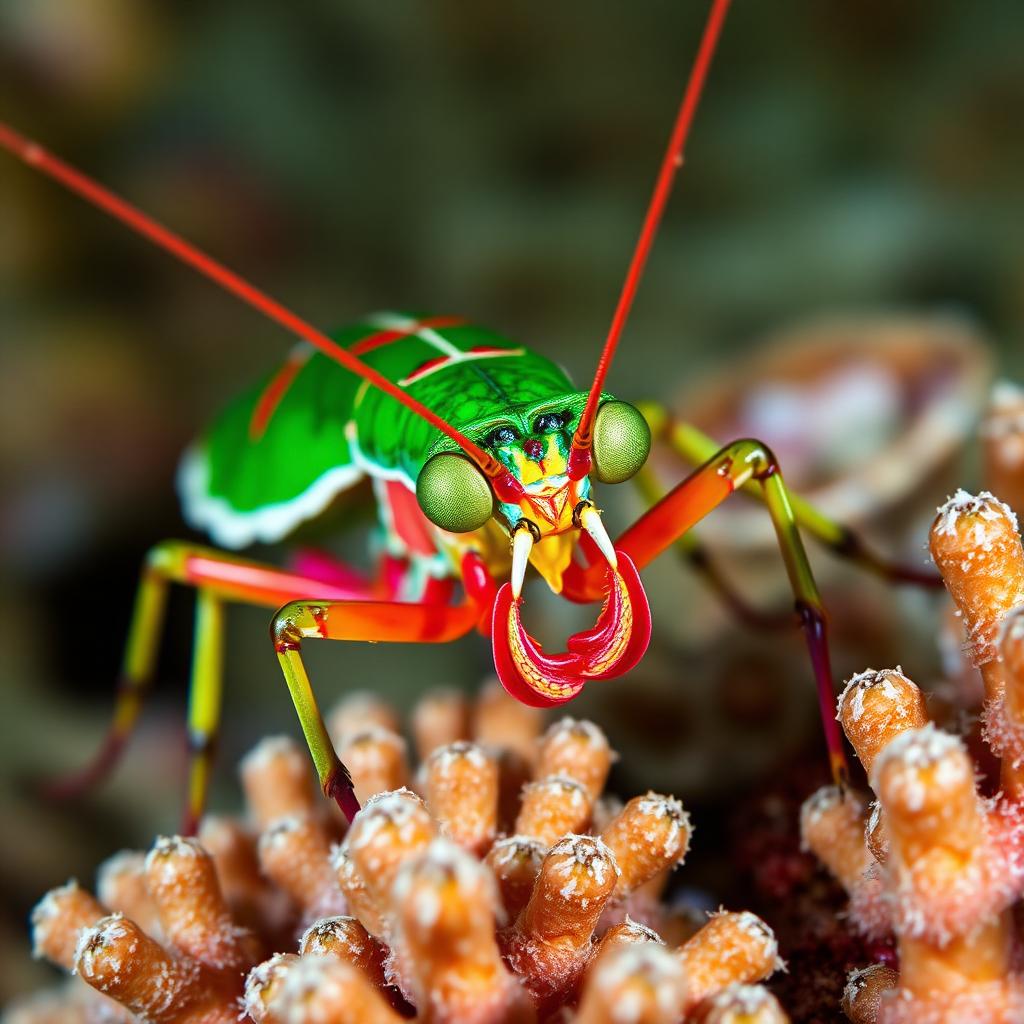
Why the Mantis Shrimp Has 16 Color Receptors
Humans see the world through 3 color receptors. The mantis shrimp uses 16 — including channels for ultraviolet and circularly polarized light no other known animal can detect.
Quick Answer
The mantis shrimp has 16 types of photoreceptor cells in its eyes, compared to only 3 in humans and 4 in most birds. Instead of mixing signals like our brains do, each receptor is tuned to a specific wavelength and reports directly. It is the only animal known to detect circularly polarized light.
Mantis shrimp are marine crustaceans, most famously the peacock mantis shrimp (Odontodactylus scyllarus), that live in shallow tropical reefs. Their compound eyes sit on independently moving stalks and can rotate almost 360 degrees. Each eye is split into three sections — dorsal, ventral, and a central band — allowing every eye to have its own trinocular depth perception.
Where humans blend red, green, and blue signals into perceived color, the mantis shrimp appears to skip the mixing step. Research by Marshall and colleagues (University of Queensland) shows the animal likely uses each of its 12 color-tuned photoreceptors as a dedicated detector, producing a fast, hard-wired classification of color rather than a fine gradient. The remaining photoreceptors handle ultraviolet and polarization.
The most extreme part of their vision is polarization sensing. Mantis shrimp are the only animals known to detect circularly polarized light — a corkscrew-like twisting of light waves. They use it to send private signals to other mantis shrimp: their carapaces reflect circularly polarized patterns that predators and prey cannot see. This is essentially a natural, biological encryption channel.
Their vision pairs with equally extreme motor abilities. The peacock mantis shrimp punches prey with clubbed appendages that accelerate faster than a .22 caliber bullet, generating cavitation bubbles that briefly reach temperatures near the surface of the Sun. Between the eyes and the punch, the mantis shrimp is one of the most measurably superlative animals in the ocean.
Key Fact
Mantis shrimp have 16 photoreceptor types — 12 for color, and 4 for ultraviolet and polarized light — making them the only animal known to see circularly polarized light.
Why It Matters
Mantis shrimp vision is rewriting how biologists think about color perception. Their hardware-first approach — one wavelength, one detector — is being studied as a model for faster machine vision and satellite cameras that classify materials instantly instead of building high-resolution images. Their circularly polarized signaling is also inspiring new optical data-storage and secure-communication research, because polarization is invisible to conventional cameras. Understanding these animals shows that intelligence and complexity in nature often live at the sensory edge, not just in the brain.
Did You Know?
- •The peacock mantis shrimp's strike is one of the fastest movements in the animal kingdom, reaching 23 m/s in under 3 milliseconds.
- •Its punch is so powerful it produces cavitation bubbles that create a second shockwave — prey are often hit twice from a single strike.
- •Mantis shrimp are believed to be able to see cancer cells, because tumors reflect polarized light differently than healthy tissue.
- •They have been kept as reef-aquarium invaders that shatter glass walls with a single punch.
- •Despite their name, mantis shrimp are neither mantises nor shrimp — they belong to their own order, Stomatopoda, which split from other crustaceans over 400 million years ago.
How Mantis Shrimp Vision Works
A quick walkthrough of the most complex eye in the animal kingdom.
- 1
Start with the eye stalks
Each eye moves independently on a stalk and can rotate almost 360 degrees, giving the animal a nearly panoramic field of view.
- 2
Count the photoreceptors
Each eye contains 16 photoreceptor types: 12 tuned to specific wavelengths of color, plus 4 dedicated to ultraviolet and polarized light.
- 3
Skip the color mixing
Instead of mixing signals like humans do, each receptor reports directly, letting the mantis shrimp classify colors extremely quickly.
- 4
Read the polarization channel
Specialized cells detect circularly polarized light, which reflects off other mantis shrimp — a private signaling system invisible to predators.
Related Facts
Frequently Asked Questions
Explore More
Explore more unique facts about extreme animals, senses, and marine biology.
Explore SnapFacts