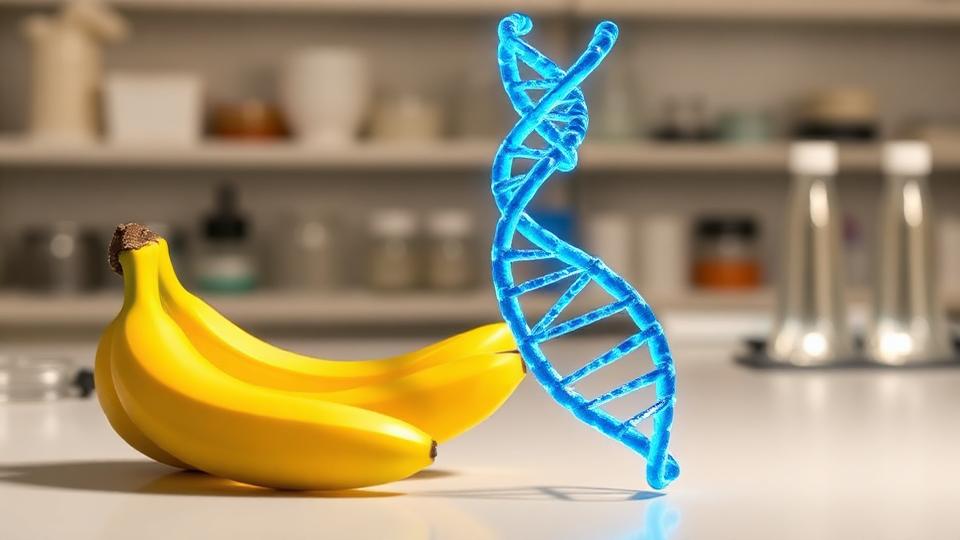
Do Humans Really Share 60% of Their DNA with Bananas?
It sounds like a joke, but genetics confirms it: you share about 60% of your DNA with the banana you had for breakfast.
Quick Answer
Yes. Humans share approximately 60% of their DNA with bananas. This is because all living organisms on Earth descended from a common ancestor and share many of the same fundamental genes for basic cellular functions.
The 60% figure refers to the proportion of human genes that have recognizable counterparts (homologs) in the banana genome. These shared genes code for fundamental biological processes that all living organisms need — things like cell division, energy production, DNA replication, and protein synthesis. These essential molecular machines evolved billions of years ago and have been conserved across the tree of life because they work so well.
To understand this, it helps to know what DNA actually does. DNA is essentially an instruction manual for building and operating a living organism. While humans and bananas look completely different, at the molecular level both are made of cells that need to perform many of the same basic functions: converting food into energy, copying DNA when cells divide, repairing damaged proteins, and managing waste. The genes that control these processes are remarkably similar across species.
The key insight is that shared DNA doesn't mean shared traits. The 40% of DNA that differs between humans and bananas is what creates the enormous differences in physical form, complexity, and behavior. Humans share about 98.7% of DNA with chimpanzees, 85% with mice, 80% with cows, and 60% with fruit flies — and about 60% with bananas. The decreasing percentages correlate with increasing evolutionary distance.
This genetic commonality is one of the strongest pieces of evidence for evolution and common descent. All life on Earth — from bacteria to bananas to humans — shares the same genetic code (DNA uses the same four nucleotide bases: A, T, G, C) and the same basic molecular machinery. This universal genetic language points to a single origin of life approximately 3.8 billion years ago.
Key Fact
Humans share approximately 60% of their DNA with bananas because all life on Earth evolved from a common ancestor and uses the same fundamental genetic code.
Why It Matters
Understanding cross-species DNA similarity is foundational to modern medicine and biology. The shared genes between humans and other organisms are why we can use model organisms in medical research — studying fruit flies, mice, and even yeast has led to breakthroughs in understanding cancer, aging, and genetic diseases. Comparative genomics helps scientists identify which genes are essential for life, which ones drive specific traits, and how mutations lead to disease. It also has practical applications in agriculture, where understanding plant genetics helps develop disease-resistant crops.
Did You Know?
- •Humans share about 98.7% of DNA with chimpanzees, 93% with mice, 80% with cows, 70% with slugs, and 60% with both bananas and fruit flies.
- •All humans are 99.9% identical in their DNA. The 0.1% difference accounts for all the variation in appearance, disease susceptibility, and other traits between individuals.
- •If you stretched out all the DNA in a single human cell, it would be about 2 meters long. If you stretched out all the DNA in your entire body, it would reach the Sun and back over 600 times.
- •Humans have about 20,000-25,000 genes — surprisingly similar to the number in a grape plant (about 30,000). Gene count doesn't determine organism complexity.
- •The banana genome was fully sequenced in 2012. Scientists found it has about 36,000 genes — actually more than humans.
How to Understand DNA Similarity Between Species
Why humans share DNA with bananas and what it actually means.
- 1
Understand shared genetics
All living things share a common ancestor, so fundamental biological processes — cell division, energy production — use similar genes.
- 2
Know the numbers
Humans share about 60% of DNA with bananas, 85% with mice, and 98.7% with chimpanzees.
- 3
Interpret correctly
Shared DNA doesn't mean we're 60% banana. It means 60% of our genes have recognizable counterparts in banana DNA, mostly for basic cellular functions.
Related Facts
Frequently Asked Questions
Explore More
Explore more fascinating facts about genetics, science, and the human body.
Explore SnapFacts