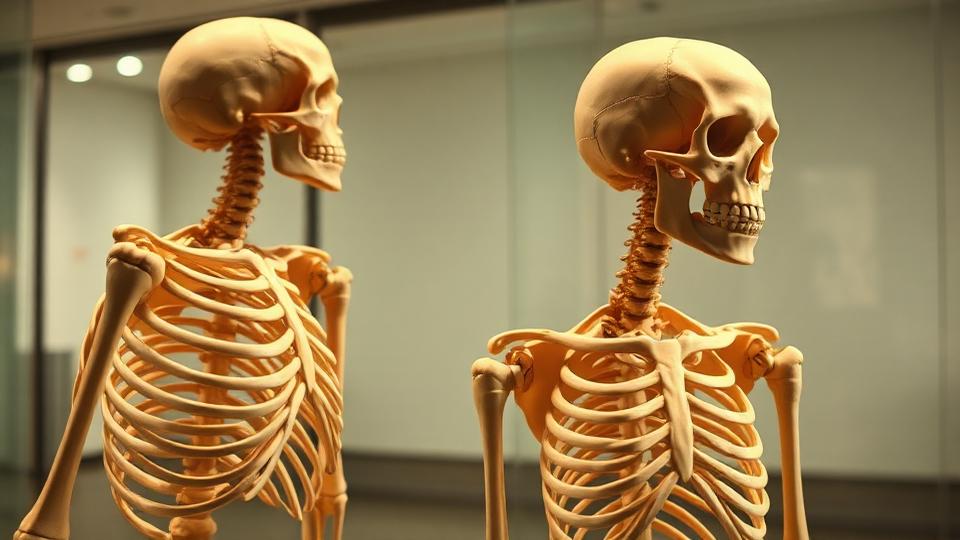
How Many Bones Are in the Human Body?
The textbook answer is 206 — but that number describes a typical adult, not everyone, and not the skeleton you were born with.
Quick Answer
A typical healthy adult has 206 bones. Newborns start with roughly 270–300 separate bony and cartilaginous elements, and the count falls during growth as separate elements fuse. Individual counts vary: extra ribs, extra vertebrae and sesamoid bones are common anatomical variants.
The figure of 206 is a convention used in anatomy teaching, not a measurement that holds for every person. It counts the bones of a fully grown, healthy adult skeleton and splits them into two groups: the axial skeleton (usually counted as 80 bones — skull, vertebral column, ribs and sternum) and the appendicular skeleton (usually counted as 126 bones — limbs, shoulder girdle and pelvis).
Newborns are usually described as having about 270–300 separate skeletal elements. Sources differ because many of these elements are cartilage rather than bone, and where you draw the line changes the total. Over childhood and adolescence, ossification hardens cartilage and separate centres fuse: the frontal bone halves join, the sacrum consolidates from five vertebrae, and the long bones' growth plates close in the late teens to early twenties.
The smallest bone is the stapes in the middle ear, generally reported at about 2.5–3.3 mm in length. The longest is the femur, which averages roughly 43–50 cm in adults depending on stature. The femur is also the strongest bone in terms of load it can bear along its axis — figures such as "30 times body weight" circulate widely but describe idealised compressive loading in cadaver testing, not everyday forces.
Bone is living, vascularised tissue containing nerves and marrow. Marrow produces on the order of 200 billion red blood cells per day in a healthy adult. The skeleton also remodels continuously; the frequently quoted "whole skeleton replaced every 10 years" is a rough average — trabecular bone in the spine turns over much faster than dense cortical bone in the shaft of a long bone.
Key Fact
A typical adult has 206 bones; newborns start with roughly 270–300 separate skeletal elements, and the number falls as those elements fuse during growth.
Why It Matters
Bone health determines mobility and independence for the rest of your life, and the numbers matter clinically. The International Osteoporosis Foundation estimates that osteoporosis causes millions of fragility fractures worldwide each year, and that roughly one in three women and one in five men over 50 will have an osteoporotic fracture. Knowing how the skeleton grows and remodels explains why weight-bearing exercise, adequate calcium and vitamin D, and avoiding smoking all measurably affect fracture risk. The same anatomy underpins forensic identification, palaeoanthropology and orthopaedic surgery — all of which depend on knowing what normal variation looks like rather than assuming every skeleton is identical.
Did You Know?
- •Over half your bones sit in your hands and feet: 27 per hand and 26 per foot, 106 of 206 in total.
- •The hyoid in the throat is the only bone that does not form a joint with another bone — it is suspended by muscles and ligaments and supports the tongue.
- •Bone has a high strength-to-weight ratio, but the popular claim that it is "stronger than steel" only holds for specific measures such as compressive strength per unit mass, not for strength overall.
- •Astronauts lose bone mineral density in weightlessness — measured losses of roughly 1–1.5% per month in weight-bearing bones — which is why resistance exercise is mandatory aboard the ISS.
How to Count the Bones in the Human Body
Understand how the human skeleton is organised, and why the bone count changes with age and varies between people.
- 1
Start with the adult convention
A typical adult is counted as having 206 bones — the standard figure used once all growth plates have fused.
- 2
Split it into two groups
Axial skeleton (skull, vertebral column, ribs, sternum) is usually counted as 80 bones; appendicular skeleton (limbs, shoulder girdle, pelvis) as 126.
- 3
Account for age
Newborns have roughly 270–300 separate skeletal elements, many of them cartilage, which fuse during childhood and adolescence.
- 4
Allow for variation
Extra ribs, lumbosacral variants and sesamoid bones mean an individual count can differ from 206 without being abnormal.
Sources
Every figure on this page was checked against the references below on Aug 15, 2026.
- Anatomy, Skeletal System — StatPearls — US National Library of Medicine (NCBI Bookshelf)
- Bone Health and Osteoporosis: A Report of the Surgeon General — US Department of Health and Human Services
- Epidemiology of osteoporosis and fragility fractures — International Osteoporosis Foundation
- Bone loss and human spaceflight countermeasures — NASA Human Research Program
- Human skeleton — anatomy overview — Encyclopaedia Britannica
Related Facts
- •The stapes in the middle ear is the smallest bone, about 2.5–3.3 mm long
- •The femur is the longest bone, averaging roughly 43–50 cm in adults
- •106 of your 206 bones are in your hands and feet
- •Bone marrow makes on the order of 200 billion red blood cells a day
- •Bone remodels continuously, at very different rates in different bones
Frequently Asked Questions
Explore More
Explore more facts about the human body and health.
Explore SnapFacts