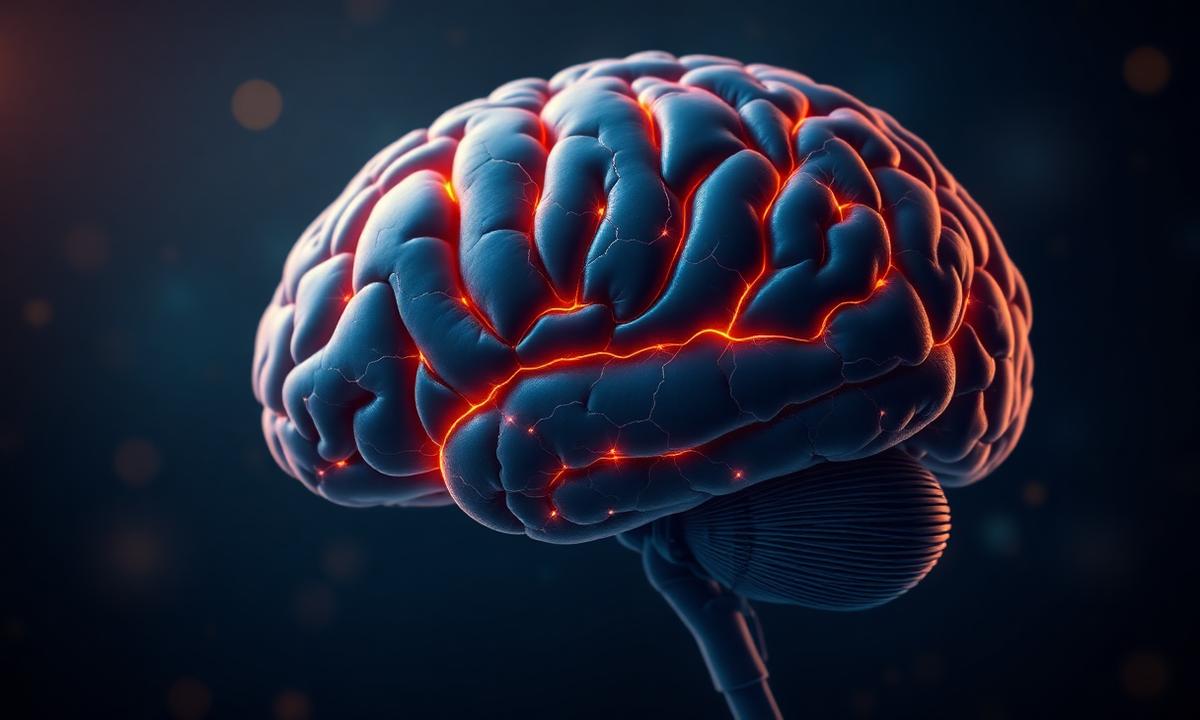
10 Mind-Blowing Human Brain Facts
Your brain weighs about 1.4 kg — but runs on less power than a light bulb while producing every thought you have ever had.
Quick Answer
The human brain contains about 86 billion neurons, weighs roughly 1.4 kilograms, and uses around 20% of the body's total energy despite making up only 2% of body mass. Neurons communicate via 100+ trillion synapses at speeds up to 430 km/h.
The brain is the most complex known object in the universe. It has approximately 86 billion neurons — a figure established in 2009 by neuroscientist Suzana Herculano-Houzel, revising the long-quoted '100 billion' estimate. Each neuron connects to thousands of others, producing more than 100 trillion synaptic links that together form the physical basis of thought, memory, emotion, and movement.
Despite weighing only about 1.4 kg (roughly 2% of body mass), the brain consumes around 20% of the body's energy — mostly glucose and oxygen delivered by a dense network of blood vessels. Even at rest it burns about 20 watts, comparable to a dim light bulb. Most of that energy powers the constant maintenance of electrical gradients across neuron membranes, not active thinking.
The brain has four main parts. The cerebrum is the large, wrinkled outer layer split into two hemispheres and four lobes (frontal, parietal, temporal, occipital) that handle thought, language, senses and voluntary movement. The cerebellum sits at the back and fine-tunes balance and motor skills. The brainstem connects the brain to the spinal cord and controls automatic functions like breathing and heart rate. Deep inside, the limbic system (hippocampus, amygdala, thalamus) manages memory, emotion and hormones.
Neural signals travel as electrochemical impulses. The fastest myelinated axons carry signals at up to 120 metres per second — around 430 km/h — while slower, unmyelinated fibres transmit at 1–2 m/s. This is why you pull your hand back from a hot stove before you consciously feel pain: reflex arcs take shortcuts through the spinal cord.
The brain is remarkably plastic. Neuroplasticity — the ability of neural circuits to rewire in response to experience — continues throughout life, though it peaks in childhood. Learning a new language, instrument, or motor skill measurably reshapes cortical maps. Even after strokes or injury, undamaged regions can take over lost functions to a surprising degree.
Memory is not stored in one place. Different systems handle different memories: the hippocampus consolidates new episodic memories, the cerebellum stores motor skills, and the amygdala encodes emotional memories. This is why someone with hippocampal damage can still learn to ride a bike but not remember doing so.
Key Fact
The human brain contains ~86 billion neurons and ~100 trillion synapses, uses 20% of the body's energy, and transmits signals at speeds up to 430 km/h.
Why It Matters
Brain science shapes medicine, education, and technology. Understanding neuroplasticity has transformed stroke rehabilitation and treatment for depression, PTSD, and learning disabilities. Discoveries about sleep's role in memory consolidation have changed how schools schedule learning and how doctors prescribe rest. Neuroscience underpins the development of brain-computer interfaces, treatments for Alzheimer's and Parkinson's diseases (which affect over 55 million people globally), and the growing field of AI, whose neural networks are loosely inspired by biological neurons. Knowing how your own brain works — how memory, attention, and emotion are built — is also one of the most practical tools for learning, working, and living well.
Did You Know?
- •1. Your brain has about 86 billion neurons and 100+ trillion synapses — more connections than there are stars in the Milky Way.
- •2. It generates roughly 20 watts of electrical power — enough to dimly light a small LED bulb.
- •3. The brain itself has no pain receptors. Surgeons can operate on awake patients because the brain cannot feel itself being touched.
- •4. About 60% of the brain is fat, making it the fattiest organ in the body. Most of it is myelin, which insulates neurons.
- •5. The brain is not a muscle — it is nerve tissue made of neurons and glial cells, with no muscle fibres at all.
- •6. You do not use just 10% of your brain. Neuroimaging shows virtually all regions are active over the course of a day.
- •7. Signals in the fastest neurons travel at up to 120 m/s — around 430 km/h.
- •8. During deep sleep, the glymphatic system flushes waste proteins (including amyloid-beta linked to Alzheimer's) out of the brain.
- •9. The brain keeps developing until roughly age 25, when the prefrontal cortex — responsible for judgement and impulse control — fully matures.
- •10. Your brain produces enough electricity in a day to power a small LED for several hours.
How to Understand the Human Brain
A quick mental model for how the brain is organised and what its key numbers actually mean.
- 1
Start with the neuron count
The brain has ~86 billion neurons, each connected to thousands of others. It is not the count that makes it powerful — it is the connections (100+ trillion synapses).
- 2
Learn the main regions
The cerebrum handles thought and voluntary movement, the cerebellum coordinates motor skills, and the brainstem runs vital automatic functions like breathing.
- 3
Remember the energy cost
The brain uses ~20% of your energy. Steady glucose, hydration, and sleep affect brain performance more than any supplement.
- 4
Respect neuroplasticity
Neural circuits change with use. Repeated learning, sleep, and deliberate practice physically reshape the brain at any age.
Related Facts
Frequently Asked Questions
Explore More
Explore more fascinating facts about the human body, the mind, and the science of everyday life.
Explore SnapFacts